CNC History
The College of New Caledonia has served the needs of students in B.C.’s Central Interior since 1969—and with the inclusion of the B.C. Vocational School, since 1962. The College region is approximately 117,500 sq. km. (or 12% of the province), with a population today exceeding 148,000. The region encompasses three school districts: #28 Quesnel, #57 Prince George, and #91 Nechako Lakes. The College offers a full range of Career, Technical, Vocational, and University Credit programming. Average annual enrollment is approximately 5,000 students.
In January 1969, the College was established on an “operating funds only” basis, with financial assistance from participating school districts and using leased facilities at the Prince George Senior Secondary School. Over the summer, faculty were hired to teach courses in the first programs to be offered at CNC.
- First Year University Arts and Science
- Administrative Science
- Data Processing
- Early Childhood Education
In September, registration was set up on the main floor of the Secondary School and 253 students registered from all participating regions. On October 10, 1969 the College held its official opening ceremony at Vanier Hall where guests received the first issue of the newly-launched student newspaper, S’quun! (“fire” in Carrier).
Leadership History
| Year | President |
|---|---|
1968 to 1970 | Wolfgang Franke |
1970 | Acting Principal, A.Enns |
1970 to 1978 | Dr. Frederick J. Speckeen |
1975 to 1976 | Acting Principal, G. Ingalls |
1978 to 1990 | Charles J. McCaffray |
1990 | Acting President, J. Blake |
1990 to 2004 | Dr. Terence Weninger |
2004 to 2006 | Ralph M. Troschke |
2006 to 2007 | Interim President, J. Bowman |
2007 to 2013 | John Bowman |
2013 to 2014 | Interim President, Bryn Kulmatycki |
2014 to 2019 | Henry Reiser |
| 2019 to 2019 | Interim President, Tara Szerencsi |
| 2019 to 2023 | Dr. Dennis Johnson |
| 2023 to present | Cindy Heitman |
| Year | Chair |
|---|---|
1968 to 1971 | Sam Evans |
1971 to 1974 | J. Galt Wilson |
1974 to 1975 | Robert Affleck |
1975 to 1976 | Findlay Dingwall |
1976 to 1977 | James Pritchard |
1977 to 1980 | Ruth Rushant |
1980 to 1982 | A. Howard Gibbon |
1982 to 1983 | Don Flynn |
1983 to 1985 | Robert Stewart |
1985 to 1987 | Glenn Barr |
1987 to 1988 | John Blunt |
1988 to 1990 | Dr. Frank Lo |
1990 to 1991 | Marion Nielsen |
1991 to 1993 | Bob Buxton |
1993 to 1995 | M. Lynne Garner |
1995 to 1996 | G. Keith Gordon |
1996 to 1999 | Marilyn G. Harkness |
1999 to 2002 | Murry Krause |
2002 to 2007 | Art Robin |
2007 to 2010 | Bruce Sutherland |
2010 to 2011 | Ray Gerow |
2011 to 2014 | Robert (Bob) Murray |
2014 – 2015 | Keith Playfair |
2015 – 2016 | Vince Prince |
2016 – 2016 | Jason Fisher |
2016 – 2018 | Robert (Lee) Doney |
2018 -2022 | Gil Malfair |
| 2022 -2025 | Shobha Sharma |
| 2025 - Present | Judy Vasily |
Our Coat of Arms
The Coat of Arms of the College of New Caledonia (CNC) was registered with the
Canadian Heraldic Authority in 1996. CNC received its Coat of Arms in an historic joint ceremony with the City of Prince George in 1996.
CNC’s Coat of Arms is a time-honoured college symbol and is not used in marketing and promotional materials or as the sole identifier of the College. The Coat of Arms is intended to be used for formal, ceremonial academic or presidential functions. It is used on formal documents like College certificates, diplomas, tuition credits, and official partnerships or declarations.
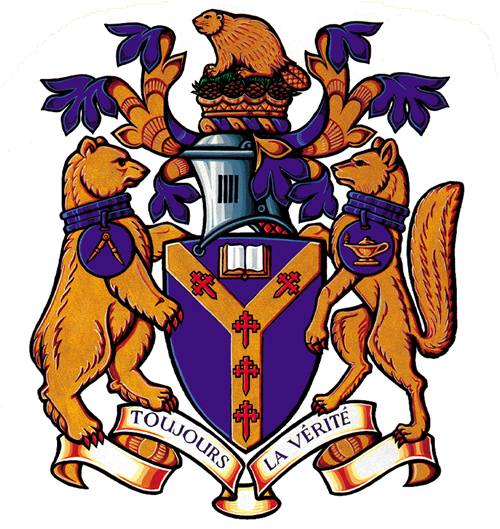
Shield of Arms
The "Y" in the Shield represents the confluence of the Fraser and Nechako Rivers at Prince George, where the College was first established. On the "Y" are five Cross Crosslets, taken from the Coat of Arms of Simon Fraser - the explorer who gave the region its early name of New Caledonia, later adopted by the College. The number Five honours the original School Districts which helped to establish the College and also represents the five main campuses of the College today. At the top of the Shield is an Open Book, a traditional symbol of learning.
Crest
A closed Helmet means the wearer is "ready for battle". Above the Helmet is a gold Coronet or crown, a link to the royally named City of Prince George. The Coronet is rimmed with Pine Cones, representing the forests of the region. At the top is a Beaver, an animal associated with diligence and in an historical context, symbolic of the early fur trade of the region and its native heritage.
Supporters
On either side of the Shield are Supporters, chosen from animals indigenous to the region. On the left is a Bear wearing a blue collar and pendant disc on which is displayed a Pair of Dividers, representing Design and Technical Studies. On the right is a Fox, wearing a disc on which is displayed a Lamp of Learning.
College Colours
Blue ("loyalty and achievement") and Gold ("prosperity").
Motto
"Toujours la Verite" (The truth always). The motto is in French, in recognition of the bilingual nature of our country.
Badge and Flag
Both the Badge and Flag have a Cross Crosslet, taken from the Shield. The Cross Crosslet is surrounded by a golden sun or Sun in Splendor. This represents the light of learning. It also associates the College with the Province of British Columbia, which has a Sun in Splendor on its Coat of Arms.